Maine Coon Cat: Size, Temperament, Care, Health, Pros and Cons
In this article
- How big does a Maine Coon get?
- Maine Coon pros and cons
- Maine Coon temperament and personality
- Appearance: ears, paws and that tail
- Maine Coon colours
- How to care for a Maine Coon
- Maine Coon health issues
- Buying a Maine Coon in the UK
- The Maine Coon as a show cat
- Where does the Maine Coon come from?
- Frequently asked questions
The Maine Coon is the largest domestic cat breed recognised by the GCCF: a semi-longhaired giant from the American state of Maine, with tufted ears, a long plumed tail and a famously gentle nature. Males usually weigh 6 to 8 kg (13 to 18 lb) and some pass 9 kg (20 lb), females 4 to 5 kg (9 to 11 lb). They take three to four years to finish growing. Below you will find what to expect from their size, temperament, coat and health, the honest pros and cons, and how to find a well-bred kitten in the UK.
In short
- Weight: males usually 6 to 8 kg (13 to 18 lb), with some reaching 9 kg (20 lb) or more. Females 4 to 5 kg (9 to 11 lb), occasionally up to 6 or 7 kg.
- Size: about 25 to 41 cm (10 to 16 in) at the shoulder for males, 25 to 35 cm (10 to 14 in) for females. A long, muscular body and a tail at least as long as the back. Fully grown at three to four years.
- Lifespan: the PDSA gives 12 to 15 years, the GCCF 10 to 15 years.
- Coat: a shaggy double coat, shorter on the shoulders and longer on the belly, "trousers" and tail. It sheds heavily in spring. Comb several times a week.
- Temperament: friendly, playful and patient. Follows you from room to room but is rarely a lap cat. Speaks in soft chirps and trills.
- Cost in the UK: the PDSA puts the average purchase cost at £450 and the lifetime cost of essentials at £13,600 to £16,900. Kittens from GCCF-registered, health-tested parents usually cost more than that average.
How big does a Maine Coon get?
A grown male Maine Coon typically weighs 6 to 8 kg (13 to 18 lb). The GCCF gives the breed a range of 10 to 20 lb and says males can reach 18 to 20 lb, and the American Cat Fanciers' Association (CFA) notes that males regularly reach or exceed 20 lb. Females are clearly lighter at 4 to 5 kg. For comparison, an average moggy weighs around 4 kg. The PDSA gives an average weight of 7 kg across the breed.
Most of that weight is frame. A Maine Coon has heavy bones, a broad chest and a long, rectangular body, which is why it looks even bigger than the scales suggest. The longest domestic cat Guinness ever measured was a Maine Coon called Stewie, at 123 cm (48.5 in) from nose to tail tip.
Maine Coons grow slowly. The CFA says up to three years, the GCCF up to four. A gangly one-year-old male is right on schedule and still has a long way to go. Our guide to when cats stop growing explains how this compares with other breeds.
| Male | Female | |
|---|---|---|
| Adult weight | 6 to 8 kg (13 to 18 lb), some 9 kg (20 lb) or more | 4 to 5 kg (9 to 11 lb), sometimes 6 to 7 kg |
| Height at the shoulder | 25 to 41 cm (10 to 16 in) | 25 to 35 cm (10 to 14 in) |
| Fully grown | 3 to 4 years | 3 to 4 years |
Maine Coon pros and cons
The Maine Coon is an easy cat to live with, but its size and coat ask something of you. Hold these points up against your home and your diary before you reserve a kitten.
Pros
- Sociable and patient. The GCCF calls the breed sweet-natured, friendly and affectionate, and says it bonds strongly with its family and can get on with other cats and dogs.
- Company without being clingy. A Maine Coon likes to be in the same room as you and will happily lie beside you, but it can also entertain itself.
- A soft voice. Most Maine Coons speak in chirps and trills. The exception is often dinner time, when the GCCF says they may yowl.
- Clever and trainable. According to the GCCF, Maine Coons can learn to fetch, walk on a lead and open doors. The playful kitten phase lasts for years.
- A practical coat for a longhair. The glossy topcoat is water-resistant and tangles less than a Persian's. Regular combing keeps it in good shape.
Cons
- Everything needs to be a size up. A standard litter tray, cat tree or carrier is too small. Expect to pay more for bigger, sturdier kit.
- They shed. In spring especially, a lot of undercoat comes out. Without combing, mats form on the belly, armpits and back legs.
- Inherited health risks. The breed has a higher risk of the heart disease HCM, hip dysplasia and the muscle disease SMA. Buy only from a breeder who tests.
- Expensive to buy and keep. A pedigree kitten costs more than most breeds, and a big cat eats more.
- Not made to be alone all day. A Maine Coon is very people-focused. If you are out for long hours, a second cat often helps.
- Prone to putting on weight. The GCCF warns that the breed gains weight easily, and extra kilos are hard on big joints.
Maine Coon temperament and personality
The nickname "gentle giant" fits well. A Maine Coon is calm indoors, then suddenly thunders down the hallway when the mood takes it. It is curious, comes to see who is at the door and wants to know what you are doing in the kitchen. With strangers and new situations it can be reserved at first.
Most Maine Coons want to be near you without sitting on you. The PDSA notes that they are not often lap cats and prefer running about on the floor to jumping up. They tend to settle beside you on the sofa or on a windowsill in the same room. Affectionate, then, but in their own way and with an independent streak.
The voice is typical of the breed. Instead of a loud meow you hear a chirp, a trill or a short coo, often as a greeting. Some individuals are chattier than others, and the PDSA describes them as cats that like to "chat" with their owners.
Maine Coons usually get on with other pets, dogs included, as long as you introduce them slowly. Our guide on how to introduce cats walks you through it. Their patience also makes them a popular family cat. Teach children to lift a big cat with one hand under the chest and one under the back legs. More family-friendly breeds are compared in the best cat breeds for kids.
Appearance: ears, paws and that tail
You can recognise a Maine Coon by a handful of features:
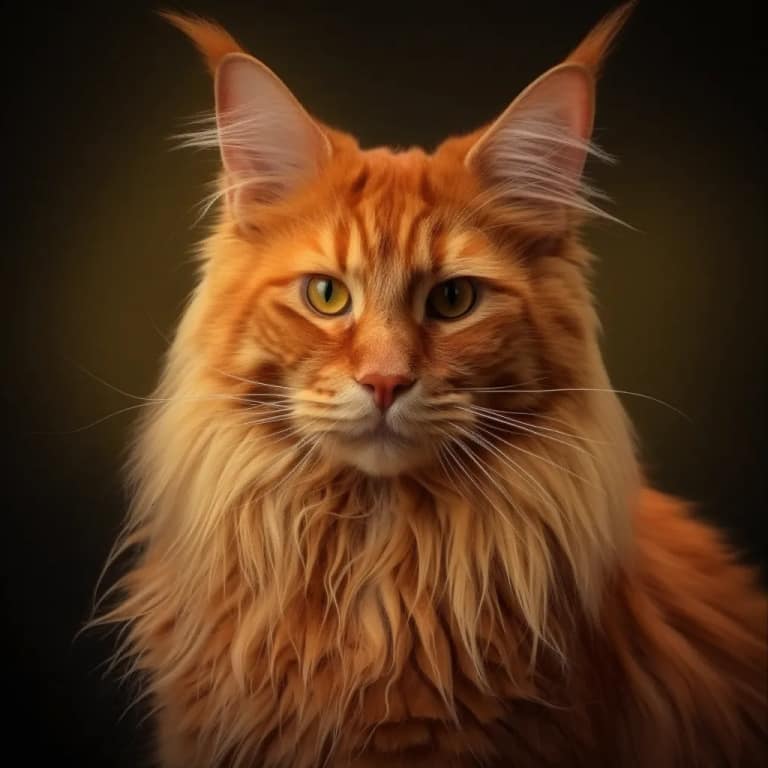
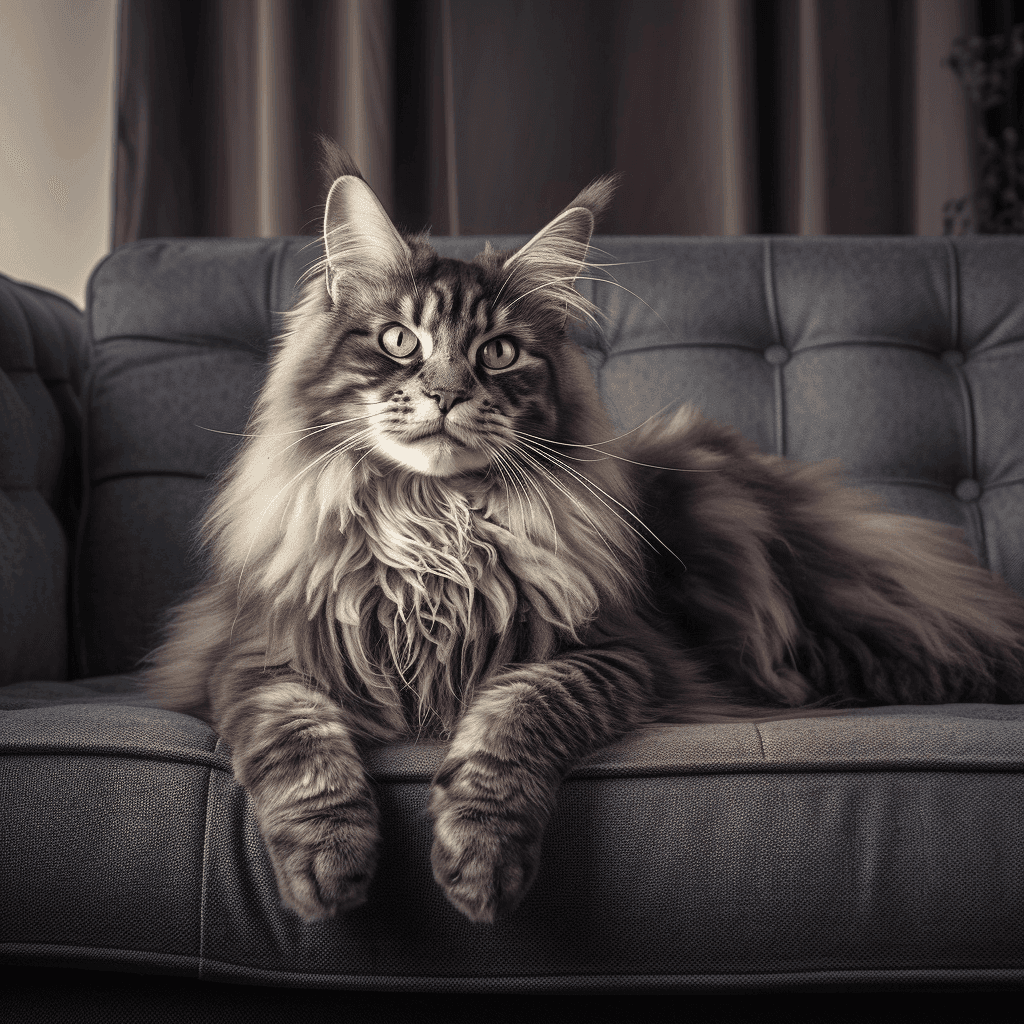
- Ears: large, tall and set high, with lynx-like tufts on the tips.
- Head and eyes: a square muzzle and large eyes in green, gold or copper. White cats may also have blue or odd eyes.
- Coat: a dense undercoat under a glossy topcoat. It is shorter on the head and shoulders and longer on the back, flanks, belly and back legs (the "breeches"). Many cats grow a frontal ruff in winter.
- Paws: large, round and tufted between the toes, like built-in snowshoes. Some Maine Coons have extra toes (polydactyly). It is inherited, and not every registry accepts it at shows.
The Maine Coon tail
The tail is one of the breed's signatures. The GCCF standard says it must be at least as long as the back. It is wide at the base, tapers towards the tip and carries long, flowing fur. A Maine Coon wraps it around its body and face when it sleeps, which in the cold of Maine was a practical way to stay warm. In a brown tabby the tail shows dark rings, which is where the old "raccoon" story comes from (more on that below).
Maine Coon colours
Almost every colour and pattern is allowed. The best known is brown tabby, the classic "raccoon" look. Beyond that you will see:
- Solid: black, blue (grey), red, cream and white.
- Tabby: classic (swirled), mackerel (striped) and ticked, in brown, red, blue and cream.
- Silver, shaded and smoke: a pale base to each hair, as in a black smoke or silver tabby.
- Tortoiseshell and calico: black and red mixed, with or without white. These are almost always females.
- With white: bi-colour and parti-colour, with a white chest, belly or paws.
Red Maine Coons, better known as orange or ginger, are a story of their own because most of them are male. The genetics and every shade of red are explained in our guide to the orange Maine Coon.
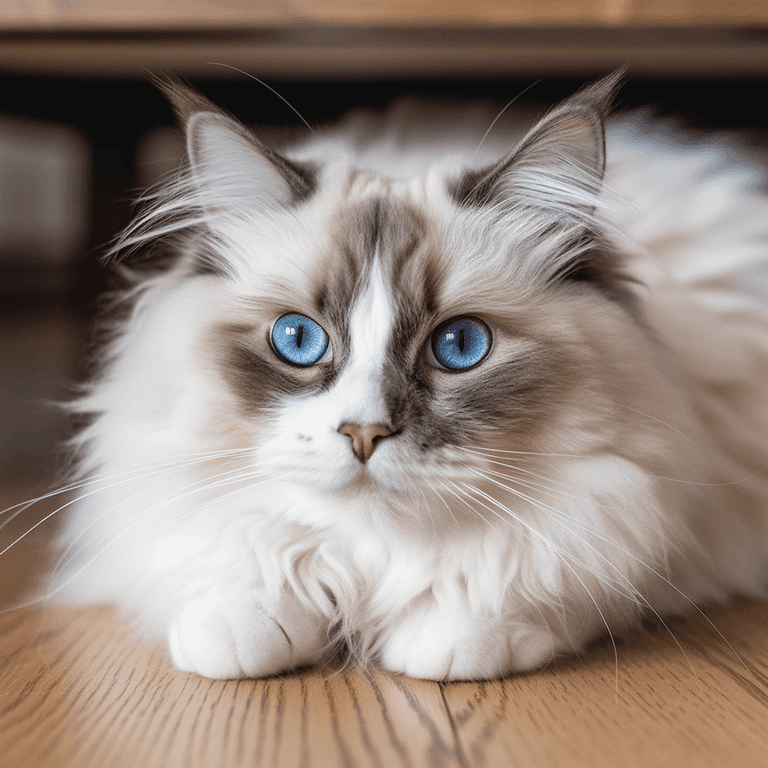
Three colours do not belong to the breed. Chocolate, lilac (lavender) and the colourpoint pattern of a Siamese or Ragdoll are not accepted by the GCCF, and the CFA treats them as a sign of crossbreeding. A "Maine Coon" offered in colourpoint is not a purebred cat.
How to care for a Maine Coon
Grooming and shedding
The topcoat rarely causes trouble. The undercoat is where mats form, especially behind the ears, in the armpits, on the belly and in the breeches. Comb those areas several times a week with a metal comb that has wide and narrow teeth. The GCCF recommends at least weekly grooming, the PDSA advises daily attention, and in the spring moult daily combing is no luxury. Start when your cat is a kitten, so grooming becomes a normal part of the day.
If you find a tight mat, do not pull it and do not cut it with scissors close to the skin. Cat skin is thin and easy to nick. Work it loose with your fingers and a comb, or ask a groomer or your vet to clip it. Regular combing also means less swallowed hair and fewer hairballs.
Bathing is rarely needed. Do check the ears every week (the GCCF mentions this specifically), look at the teeth for tartar and trim the claws when they start to catch. Big cats have big claws, and our guide to cat nail clippers shows how to trim them safely. For the hair on your sofa and clothes, see our tips on cat hair removal.
Feeding and weight
Maine Coons do not need a special breed food. A complete cat food that suits their age and weight is enough, with fresh water always available. Because the breed gains weight easily, weigh your cat now and then and ask your vet how much your cat needs, especially once it is neutered. Treats count too. Our guide to good cat food explains what to look for on the label.
Litter box size
Most litter trays in pet shops are made for a 4 kg cat. A grown Maine Coon ends up with its back feet on the rim or pees just over the edge. International Cat Care advises a tray at least one and a half times the length of your cat, measured from nose to the base of the tail. For a big male that easily means 60 cm or more. A large open tray or a big storage box with a cut-out entrance often works better than a covered box, since many hoods are too low for a cat this size.
If you are thinking about a self-cleaning model, check the maximum cat weight and the size of the entrance first, because that is where most models fall short for a Maine Coon. Our guide to the best automatic cat litter boxes lists which ones fit a large cat.
Cat tree, bed and carrier
- Cat tree: choose a tall, heavy one with a wide base, thick posts and platforms big enough for a cat to stretch out. Light trees made for average cats wobble when 7 kg lands on top. The GCCF specifically mentions a strong climbing frame.
- Bed: many Maine Coons like to lie fully stretched out, so a round bed for a normal cat is often too small.
- Carrier: 8 kg of cat plus the carrier is heavy on one handle. Pick a large, sturdy carrier with a shoulder strap or one that opens from the top. Tips for longer trips are in how to travel with a cat by car.
Exercise and play
A Maine Coon is calm indoors, yet it needs daily play to stay fit and avoid boredom. Royal Canin suggests two or three sessions of five to ten minutes a day. A wand toy it can chase and jump after works well, and puzzle feeders keep its brain busy. Play also helps keep the weight off, and extra kilos are hard on the hips of a big cat.
Indoors or outdoors?
Maine Coons can live happily indoors or with outdoor access. Many owners keep them in to protect them from traffic and theft, because a pedigree cat that is this friendly is easy to pick up. If you want your cat outside, a cat-proofed garden or an enclosure is a safe middle ground. Our guide to keeping cats in the garden has ideas. Supervised walks are another option: the GCCF notes that Maine Coons can learn to walk on a lead.
Vet check-ups
Like any cat, a Maine Coon needs a yearly check-up and vaccination booster, flea and worm treatment, and neutering if you are not breeding. The yearly visit is also a good moment to have your vet listen to the heart and check weight and teeth. Ask your vet whether a heart scan makes sense for your cat, given the breed's risk of HCM.
Maine Coon health issues
The Maine Coon is a sturdy cat, but the breed has a few inherited conditions. Good breeders test their breeding cats for them, so always ask to see the results.
- HCM (hypertrophic cardiomyopathy): a thickening of the heart muscle and the most common heart disease in cats. There is a DNA test for the known Maine Coon mutation (MYBPC3, often written HCMmc), but a negative result only rules out that one mutation. That is why careful breeders also have their cats' hearts scanned by ultrasound, ideally every year or two. The Maine Coon Cat Club says breeders may not describe their cats as "HCM-free".
- Hip dysplasia (HD): a malformed hip joint that can cause lameness and arthritis. In a Swedish study of more than 5,000 Maine Coons, 37 per cent showed signs of HD on X-ray, and the risk rose with body size. There is no DNA test, but breeding cats can be X-rayed and scored, for example through the PawPeds scheme.
- SMA (spinal muscular atrophy): an inherited loss of nerve cells in the spinal cord that weakens the muscles of the back legs. Signs appear at around three to four months. Affected cats are not in pain and most live comfortably indoors, but they cannot jump well. A DNA test can identify carriers.
- PKDef (pyruvate kinase deficiency): an inherited enzyme deficiency that shortens the life of red blood cells and causes anaemia. There is a DNA test for this too.
- Patellar luxation: a kneecap that slips out of place and causes limping. The PDSA lists it alongside HCM and hip dysplasia.
For Maine Coons registered with the GCCF from mid-2024, breeding cats must test negative for HCMmc, SMA and PKDef before they go on the active breeding register, according to the Maine Coon Cat Club. That makes GCCF registration a useful first check, though no breeder can guarantee a kitten will never get ill.
See a vet straight away if your cat breathes fast or with an open mouth while resting, or suddenly cannot use its back legs and is in pain. These can be signs of heart failure or a blood clot linked to HCM, according to the Cornell Feline Health Center. A cat that is stiff, limps or tires quickly also deserves a vet visit, though less urgently.
How long a Maine Coon lives depends a lot on these conditions. The PDSA gives 12 to 15 years and the GCCF 10 to 15. More on what affects lifespan in cats in general is in how long do cats live.
Buying a Maine Coon in the UK
The safest route is a breeder registered with the GCCF, the UK's main cat registry. The GCCF website has a find-a-breeder map, and the Maine Coon Cat Club (affiliated to the GCCF) publishes a weekly list of available kittens by region. All breeders on that list have agreed to follow the GCCF Code of Ethics. TICA and FIFe-affiliated clubs also register Maine Coons in the UK.
What to ask and check, based on the Maine Coon Cat Club's advice for buyers:
- Health tests: ask for the parents' DNA results for HCMmc, SMA and PKDef, and whether the parents have had heart scans or hip X-rays. Ask to see the documents.
- The mother and the litter: you should be able to see the kitten with its mother and littermates. A breeder who refuses is a warning sign.
- Age: a kitten should be at least 13 weeks old and fully vaccinated, with the last vaccination at twelve weeks.
- Paperwork: a pedigree, a registration certificate, a vaccination record and a diet sheet when you collect your kitten, plus instructions to transfer the registration to your name.
- Health at a glance: clean, bright eyes, clean ears without black grit, no flea dirt in the coat, no pot belly and no staining under the tail.
How much does a Maine Coon cost? The PDSA puts the average purchase cost of a Maine Coon in the UK at £450, and the lifetime cost of essentials (food, litter, insurance, preventive care, toys and so on) at £13,600 to £16,900. That lifetime figure excludes the purchase price and vet treatment. The GCCF and the Maine Coon Cat Club do not set kitten prices. Each breeder decides, and the club notes that pet kittens cost less than show kittens, while breeding-quality kittens cost substantially more. Be wary of a very cheap kitten without registration papers or test results, and of sellers on "pets for sale" sites asking for a deposit before you have seen the kitten.
Adopting is also possible. The GCCF and the breed clubs run rescue and rehoming schemes, and some breeders look for a new home for a retired breeding cat. With an adult cat you already know the temperament and size you are getting. For a step-by-step guide to finding a good breeder in the UK, Ireland or the Netherlands, read how to find a Maine Coon breeder.
Maine Coons are not hypoallergenic. If someone in your home has a cat allergy, read which cats are hypoallergenic before you commit.
The Maine Coon as a show cat
Maine Coons are a familiar sight at cat shows. In the UK the GCCF granted the breed preliminary recognition in 1988 and championship status in 1993. At a show, judges compare each cat with the breed's Standard of Points: the size and rectangular body, the head and ears, the tail that is at least as long as the back, the texture of the coat and the condition the cat is in. A kitten sold as show quality is one the breeder expects to match the standard closely. A pet-quality kitten from the same litter can be just as healthy and lovely.
Where does the Maine Coon come from?
Nobody bred the Maine Coon on purpose. It is one of the oldest natural breeds in North America and most likely descends from domestic cats that came over with European settlers and sailors to New England. In the harsh winters of Maine, the cats with thick, water-resistant coats, big tufted paws and a sturdy build survived best. Farmers and sailors valued them as mousers.
A few colourful legends surround the name. One says the breed came from a cross between a cat and a raccoon, because of the ringed tail of brown tabbies. That is genetically impossible. Another claims Marie Antoinette shipped her cats to Maine when she planned her escape from France. That is a legend too. A link with wildcats such as the bobcat or lynx, which you also see mentioned, has no basis either.
Maine Coons were shown at New England agricultural fairs as early as the 1860s. At the first major American cat show, at Madison Square Garden in May 1895, a brown tabby female called Cosey was named Best Cat. After that the breed fell out of fashion, and by the 1950s it was so rare that it was rumoured to be extinct. Breeders kept it going, and in 1976 the CFA granted it championship status. The first Maine Coons reached the UK in 1984, the Maine Coon Cat Club was founded in 1985, and today it is one of the most popular pedigree breeds in the country. It is also the official state cat of Maine.
Frequently asked questions
How big does a Maine Coon get?
Males usually weigh 6 to 8 kg (13 to 18 lb), and some reach 9 kg (20 lb) or more. Females weigh 4 to 5 kg (9 to 11 lb). They stand roughly 25 to 41 cm (10 to 16 in) at the shoulder and keep growing until they are three or four years old.
Is it Maine Coon or Main Coon?
The correct spelling is Maine Coon, with an e, because the breed is named after the US state of Maine. "Coon" refers to the raccoon, a nod to the ringed tail of brown tabbies. You will also see it written as Main Coon or Maincoon.
Are Maine Coons good family pets?
Usually, yes. The breed is known for being patient, friendly and good with children and other pets. Teach children to lift a big cat properly and give the cat places to retreat to. A Maine Coon is happiest in a home where someone is around for much of the day.
What are the biggest downsides of a Maine Coon?
Their size, which means bigger and more expensive litter trays, cat trees and carriers. The shedding and mats on the belly and back legs. A higher risk of HCM, hip dysplasia and SMA. And a high purchase price, plus a cat that does not like being alone all day.
Do Maine Coons shed a lot?
Yes. They have a double coat and lose a lot of undercoat, especially in spring. Comb several times a week, and daily during the moult. That keeps mats and hairballs to a minimum.
How long do Maine Coons live?
The PDSA gives a lifespan of 12 to 15 years and the GCCF 10 to 15 years. Inherited conditions such as HCM play a part, which is why buying from a health-testing breeder and keeping your cat at a healthy weight both matter.
How much does a Maine Coon cost in the UK?
The PDSA gives an average purchase cost of £450 and a lifetime cost of essentials of £13,600 to £16,900, excluding the purchase price and vet treatment. Kittens from GCCF-registered breeders with health-tested parents usually cost more than the average. Breeders set their own prices.
Can a Maine Coon live in a flat?
It can, as long as it has enough to do. Height matters more than floor space: a sturdy, tall cat tree, a windowsill to watch the world from and daily play. A second cat helps if you are out a lot.
What is the rarest Maine Coon colour?
There are no reliable figures. Brown tabby is the classic and most familiar colour. Chocolate, lilac and colourpoint are not part of the breed, so a "rare" Maine Coon in those colours has almost certainly been crossed with another breed.