Best Automatic Cat Litter Boxes (2026): Which One Suits Your Cat?
In this article
- Which automatic litter box suits your cat?
- Our picks: the best automatic litter boxes in the UK
- Rotating, rake or sifting: how the types work
- Safety: sensors, cat weight and kittens
- Size: the best automatic litter box for large cats
- The best automatic litter box for multiple cats
- Running costs: liners, filters, trays and litter
- How noisy is an automatic litter box?
- Apps, Wi-Fi and subscriptions
- What a smart litter box can tell you about your cat's health
- What UK cat charities say, and is there a Which? test?
- Maintenance: what you still do yourself
- Getting your cat used to an automatic litter box
- Automatic litter box or ordinary litter tray?
- Frequently asked questions
An automatic cat litter box notices when your cat has been, waits a few minutes for the litter to clump, then sifts out the waste and drops it into a sealed drawer or bag. You empty that drawer every few days instead of scooping every day. For most cats, a rotating model with an app works well. If you have a large cat or several cats, look first at the maximum cat weight and the size of the entrance, because that is where most models fall short.
This article contains affiliate links How it works
Katdootje earns a small commission if you buy through a link in this article. It costs you nothing extra and does not influence what we recommend. As an Amazon Associate, Katdootje earns from qualifying purchases.
In short
- Best for large cats and multiple cats: Litter-Robot 4. Whisker rates it for cats from 1.36 to 11.33 kg (3 to 25 lb) and up to four cats, with a 40 x 40 cm entrance. Why we chose it
- Best enclosed drum for cats up to 8 kg: PETKIT Pura Max 2. A low 20 cm step-in, a big 7-litre waste bin and an app that tells your cats apart by weight. Why we chose it
- Best open-top model: Neakasa M1 Plus. No hood, so it suits cats that refuse covered boxes, and Neakasa rates it up to about 15 kg. Why we chose it
- Simplest, with no app: PetSafe ScoopFree (second generation). A rake model with disposable crystal trays. Cheaper to buy, dearer to run. Why we chose it
- Got a kitten or a very nervous cat? Start with an ordinary litter tray and switch later. You will read why below.
Which automatic litter box suits your cat?
No single automatic litter box is best for every cat. Whether a model works for you comes down to three things: how big and heavy your cat is, how many cats share the box, and how your cat reacts to a box that moves and hums.
- One cat of average size: an enclosed drum such as the Pura Max 2 is plenty. Check the weight limit anyway.
- A large cat such as a Maine Coon: males of this breed typically weigh 6 to 8 kg (13 to 18 lb), and some go well past that, according to our Maine Coon guide. That puts them at the limit of many drum models. Choose a high maximum weight and measure the entrance.
- Two or more cats: look at how many cats the manufacturer says the box handles and whether the app can tell your cats apart by weight.
- A cat that hates hoods: if your cat already prefers an open tray, an open-top automatic model is the safer bet.
- A kitten: keep the automatic cleaning switched off until your kitten is above the manufacturer's minimum weight or age.
Our picks: the best automatic litter boxes in the UK
We have not run these boxes side by side in our own test. Our picks are based on what the manufacturers state about size, cat weight and safety, on the litter each one needs, and on what owners report on Amazon UK after weeks and months of use. All four were in stock on Amazon UK when we checked in October 2026.
Whisker now also sells the Litter-Robot 5 in the UK through its own website. It is rated for cats from 1.4 to 13.6 kg and up to five cats and can tell wees from poos, but it costs more again and was not on Amazon UK when we checked.
The four side by side
| Litter-Robot 4 | PETKIT Pura Max 2 | Neakasa M1 Plus | PetSafe ScoopFree | |
|---|---|---|---|---|
| Type | Rotating globe with sifting screen | Rotating drum, enclosed | Open tray that rotates and sifts | Rake over disposable crystal tray |
| Cat weight (manufacturer) | 1.36 to 11.33 kg | Up to about 8 kg (18 lb) | 1 kg to about 15 kg | Not stated |
| Number of cats | Up to 4 | Several, no fixed number given | Several, no fixed number given | Single or multi-cat, "mileage may vary" |
| Entrance | 40 x 40 cm opening | 20 cm step-in | Open, about 35 cm high | Low, hood with opening |
| Waste storage | Drawer in the base | 7-litre sealed bin | 11-litre bin | Covered compartment in the tray |
| Litter | Clumping clay works best | Clumping litter, no crystals | Fast-clumping litter | Crystal litter only |
| Kittens | Automatic mode from 1.36 kg | From six months, kitten mode | Kitten mode under 1 kg | Unplugged until six months |
| App | Yes, weighs each cat | Yes, weighs each cat | Yes, weighs each cat | No, usage counter on the box |
| Best for | Large cats, up to four cats | One or two average-sized cats | Cats that avoid hoods | Owners who want no app and a lower upfront cost |
Rotating, rake or sifting: how the types work
An automatic litter box, also called a self-cleaning or smart litter box, always does three things in a row. Sensors notice your cat going in and coming out. The box waits a few minutes so the urine can clump. Then a motor separates the clumps from the clean litter and stores them in a closed drawer or bag. How it does that last step depends on the type.
Rotating globe or drum
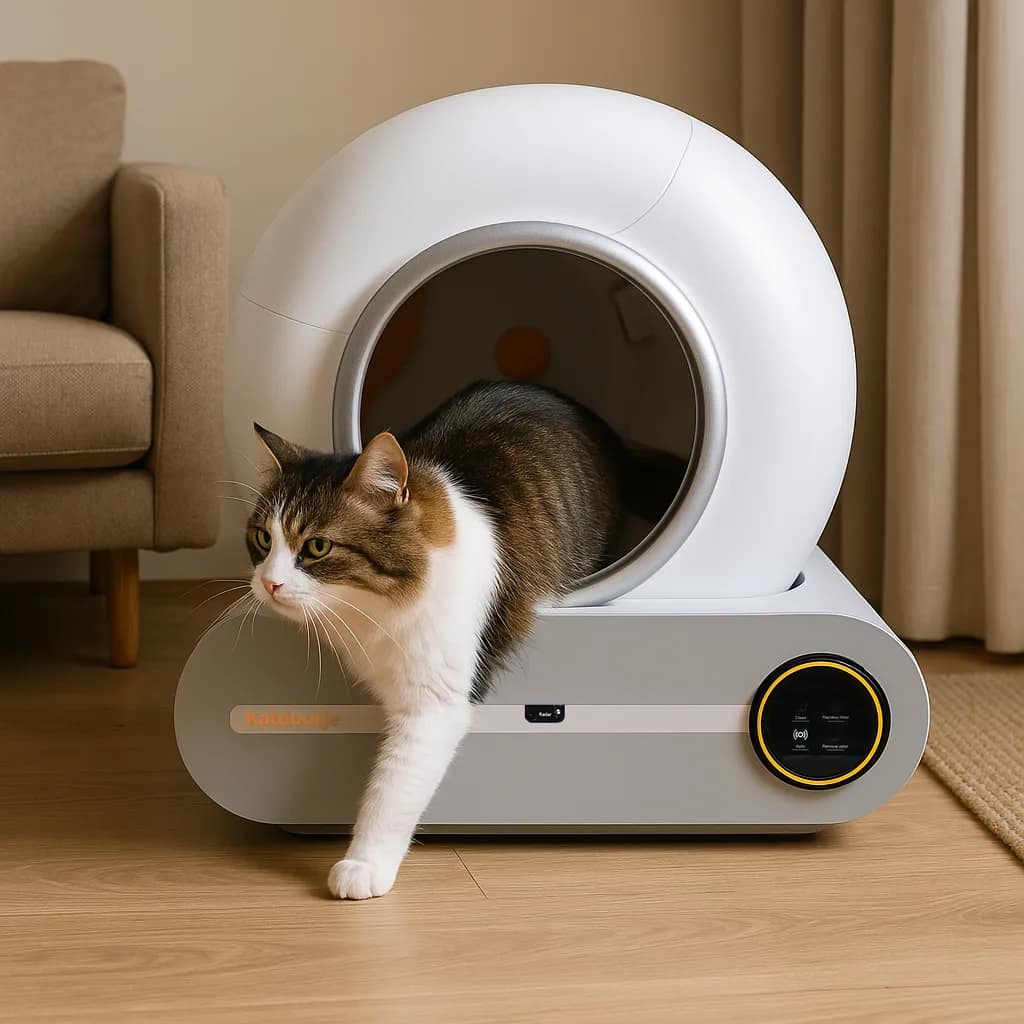
This is the most common type today. The litter sits in a globe or drum that slowly turns after the waiting time. A built-in screen holds back the loose litter, and the clumps fall through an opening into the drawer or bin below. The drum then turns back and the litter lies flat again. The Litter-Robot 4 and the Pura Max 2 work this way.
These boxes are big and enclosed, and your cat walks in through an opening. A cat that distrusts hooded trays usually needs more time to get used to them.
Open-top sifting tray
The same idea without the hood. The tray tilts and turns to sift the litter, and your cat stands in the open while using it. The Neakasa M1 is the best-known example. This suits cats that feel trapped in a globe, at the cost of more litter kicked onto the floor.
Rake
In a rake box, the litter lies in a flat, open tray. After the waiting time, a rake slowly moves through the litter and pushes the solids into a closed compartment at the end. The PetSafe ScoopFree uses disposable trays filled with crystals, which you replace in one go every few days to few weeks, depending on how many cats you have.
Many cats like a rake box because it looks like an ordinary tray. The weak point is the rake itself. Soft or wet stools stick to the tines or get smeared, and then you clean the rake by hand. With disposable trays you are also tied to the manufacturer's refills.
Flushing and manual sifting boxes
Some boxes wash reusable granules with water and dry them, which means plumbing them into a tap and a drain. You rarely see them in UK homes. At the other end of the scale, a manual sifting tray is two or three nesting trays, one with a grid as its base. You lift the top tray, the clean litter falls through and you throw the clumps away. Cheap and silent, but it is still you doing the work.
Whatever the type, an automatic box runs on mains power. Plan a spot near a socket, on a hard, level floor.
Safety: sensors, cat weight and kittens
Sensors
A box that moves while your cat is inside is the one thing you must avoid. Choose a model with several sensors that pause or cancel the cycle as soon as a cat steps in or comes close. Most use a weight sensor in the base, often combined with infrared or laser sensors at the entrance. Avoid designs where the entrance closes during cleaning, and read the reviews on this point carefully for cheap no-name boxes. One Litter-Robot owner felt her cats could reach too far into the globe while it was still turning, and preferred the PETKIT's sensors, which stop the cycle when a cat is merely near the entrance.
Minimum and maximum cat weight
Manufacturers give a minimum and a maximum weight. The minimum exists because the weight sensor may not notice a very light cat, and then the box does not know a cat is inside. The maximum says something about the space inside. Stick to both.
Kittens
Every manufacturer in this guide has a rule for kittens. Whisker recommends automatic mode on the Litter-Robot 4 only from 1.36 kg. Below that, you leave it switched off, wait about seven minutes after your kitten has used it, then switch it on so it runs one cycle. PETKIT advises against the Pura Max 2 for kittens under six months, Neakasa has a kitten mode for cats under 1 kg, and PetSafe says to leave the ScoopFree unplugged until six months. Until your kitten qualifies, use the box as an ordinary tray or keep a low-sided tray next to it. Which litter suits young cats is covered in our guide to the best cat litter for kittens.
Size: the best automatic litter box for large cats
Battersea's advice for any litter tray is that it should be big enough for your cat to stand, turn around and dig, ideally at least one and a half times your cat's length from nose to base of the tail. Most automatic boxes are smaller than that inside, so for a large cat the numbers matter.
- Litter-Robot 4: up to 11.33 kg, 40 x 40 cm entrance, 41.9 cm interior height. The Litter-Robot 5 goes up to 13.6 kg with a little more room inside.
- Neakasa M1: up to about 15 kg, and the open top means there is no ceiling. One owner of a very heavy Maine Coon still found it "super tight", so the tray itself is not huge.
- Pura Max 2: up to about 8 kg. Fine for most cats, tight for a fully grown male Maine Coon.
Measure your cat before you buy. A cat that has to duck or cannot turn around tends to go elsewhere. For a big cat, an open-top model or a large globe is the safer choice.
The best automatic litter box for multiple cats
"Best automatic litter box for multiple cats" is one of the things people search for most, and the honest answer is that one box rarely replaces all your trays. Battersea's rule of one tray per cat plus one extra still applies. An automatic box makes a busy tray cleaner between visits. It does not stop cats from guarding a single toilet.
- Capacity: Whisker rates the Litter-Robot 4 for up to four cats and says the drawer can last as long as eight days. A French owner with five cats changes the bag about every four days. Neakasa and PETKIT give no fixed number of cats, and their "14 to 15 days" claims are for one cat.
- Telling cats apart: all three app models identify cats by weight. That works when your cats differ by a kilo or more. With littermates of similar size, owners regularly report mixed-up records.
- A backup tray: keep at least one ordinary tray in another room. If the automatic box jams, is full or is mid-cycle, your cats still have somewhere to go.
For two or three cats, the Litter-Robot 4 is our pick. If one of your cats avoids hoods, an open-top Neakasa next to an ordinary tray often works better than a single globe. Introducing a new cat to the household as well? Read how to introduce cats first, because a new box and a new cat at once is a lot of change.
Running costs: liners, filters, trays and litter
The price on the box is only part of the bill. Every automatic litter box has consumables, and they differ a lot per system.
| What you keep buying | How often (manufacturer and owners) | |
|---|---|---|
| Litter-Robot 4 | Clumping clay litter, carbon filters, optional drawer liners (ordinary bin bags work too, owners say) | Filter every two to four weeks according to Whisker |
| PETKIT Pura Max 2 | Clumping litter, PETKIT bin liners, N50 odour eliminator cartridges, eventually a new drum mat | Odour cartridge about every 30 days according to PETKIT |
| Neakasa M1 Plus | Fast-clumping litter, bin bags, eventually a new tray mat | Bags last about a week for one cat and four to five days for three cats, owners report. Some replace the mat after ten months or so |
| PetSafe ScoopFree | Disposable crystal trays, or a reusable tray with bags of crystal litter | Owners report one tray lasting five to seven days with two cats, and about three days with three |
| All of them | Electricity, and an occasional replacement part | Continuous |
Drum and globe boxes often use less litter than an ordinary tray, because only the clumps leave. Several owners mention this. The ScoopFree is the odd one out: cheap to buy, expensive to run once you have more than one cat. Over a year, its trays can cost more than the price gap with a drum.
How noisy is an automatic litter box?
Every automatic box makes a noise while it cleans, usually a low motor hum for a couple of minutes. Manufacturers quote figures such as 35 dB for the Pura Max 2 and 50 dB or less for the Neakasa M1, which are their own measurements. Whisker does not give a figure and calls its system "QuietSift". In UK reviews, owners of all three describe them as quieter than expected, and one says her cat sleeps next to the Pura Max 2 while it runs.
Noise is less of a problem than the movement itself for a nervous cat. If the box is in a bedroom or your cat startles easily, choose a model where you can lengthen the delay or set quiet hours in the app.
Apps, Wi-Fi and subscriptions
A smart litter box with an app shows how often each cat goes, sends a message when the bin is full and usually weighs your cat on every visit. A few things to know before you rely on it:
- Wi-Fi: most apps only connect on 2.4 GHz Wi-Fi. Wi-Fi setup is the most common complaint in UK Litter-Robot reviews, so do it close to your router.
- Floors: the weight readings are only reliable on a hard, level floor. Whisker sells a carpet tray for carpet thicker than 3 mm, and a Pura Max 2 owner fixed missed visits on a soft vinyl floor with a wooden board.
- Subscriptions: the Whisker app shows seven days of history for free. Longer history needs an optional paid plan. The box itself works fine without it.
- Without the app: all the app models also have buttons on the box. The ScoopFree has no app at all, just a counter.
What a smart litter box can tell you about your cat's health
An app that logs visits and weight is useful because cats hide pain well. If your cat suddenly goes much more often with small amounts, or much less often, call your vet. A male cat that keeps going to the box and passes little or no urine is an emergency. The PDSA warns that a blocked bladder is extremely serious and can damage the kidneys if it is not treated. Go to your vet or an out-of-hours clinic straight away.
A litter box is not a diagnosis. Treat the app as an extra pair of eyes and ask your vet if in doubt. If your cat starts going outside the box, our article on why a cat poops outside the litter box helps you find the cause. Prefer something simpler than an app? Litter that changes colour is another option, explained in health monitoring cat litter.
What UK cat charities say, and is there a Which? test?
Battersea is cautious about these boxes. Its advice on toileting says automated or self-cleaning trays can put cats off through noise, movement or smell, and it recommends avoiding covered trays where possible, because they trap smells and limit what the cat can see. That does not mean your cat will refuse one. Many cats use them without a second thought. It does mean you should watch your cat closely in the first weeks, set a long delay, keep an ordinary open tray available and consider an open-top model if your cat avoids hoods.
As far as we could find, Which? had not published a test of automatic litter boxes by October 2026. If you see a "Which? Best Buy" claimed for one, check that the test exists.
Maintenance: what you still do yourself
An automatic box saves you the daily scoop, but it is not maintenance-free. Expect roughly this rhythm, and check your manual for exact intervals:
- Every few days: empty the drawer or bag, more often with several cats. Top the litter up to the fill line while you are there.
- Every week: look for clumps stuck to the walls, the screen, the mat or the rake and remove them. Wipe the rim and the entrance.
- Every two to four weeks: replace the carbon filter or odour cartridge if your box has one.
- Every one to three months: empty all the litter and wash the globe, drum or tray with water and mild soap. Let everything dry fully before you reassemble it. Never get the base with the motor and sensors wet.
For the general routine of keeping any litter area clean, see our complete guide to cleaning the litter box. If the smell lingers in the room, how to get rid of cat pee smell covers what actually works.
When the box does not do what it should
- Clumps stick or fall apart: usually the litter is too shallow or does not clump firmly enough. Fill to the line and try a harder-clumping clay litter. Several owners solved this simply by changing litter.
- The box does not start after a visit: the weight sensor may miss a light cat or kitten. A soft or uneven floor does the same.
- The box stops halfway or says a cat is inside when there is none: dust or litter on a sensor, or something leaning against the box, is the usual cause.
- The bin says "full" too early: owners find that waste piles up in one spot under the sensor. Level it out, or check that the bag sits properly after emptying.
Getting your cat used to an automatic litter box
Put the new box where the old tray stood, leave the automatic cleaning off for the first days and keep the old tray nearby until your cat uses the new one without hesitation. Mixing a cup of used litter into the fresh litter gives a familiar smell. Most cats settle within a few days to a week, but some need much longer. Our step-by-step guide on how to train your cat to use an automatic litter box walks you through the whole process, including what to do if your cat is scared of the first cycle.
Automatic litter box or ordinary litter tray?
| Automatic litter box | Ordinary litter tray | |
|---|---|---|
| Purchase price | Roughly £200 to £700 for the boxes in this guide | Cheap, even a large one with a hood |
| Running costs | Litter, liners, filters or trays, electricity | Litter, and a new tray now and then |
| Litter | Usually only the type that suits the system | Any type |
| Daily work | Empty the drawer or bag every few days | Scoop every day |
| Smell | Clumps go into a closed drawer shortly after each visit | Depends on how often you scoop |
| Noise | A motor hum for a few minutes per cycle | None |
| Kittens | Only above the manufacturer's minimum weight or age | Yes, choose a low entry |
| Things that can go wrong | Sensors, motor, Wi-Fi | Nothing technical |
| Health tracking | Smart models log visits and weight | You see the clumps yourself when you scoop |
An automatic box suits you if you work long days, travel often, have several cats or find bending and scooping hard. Stay with an ordinary tray if you have a kitten or a very nervous cat, if you want to use a litter that does not clump, or if you would rather spend the money elsewhere. Plenty of people keep both: the automatic box as the main toilet and an ordinary tray as the spare.
Frequently asked questions
What is the best automatic cat litter box?
It depends on your cat. For large cats and homes with several cats, we pick the Litter-Robot 4 for its high weight limit, large entrance and per-cat weighing. For one or two average-sized cats, the PETKIT Pura Max 2 does the job for less money. If your cat avoids hooded boxes, go for the open-top Neakasa M1 Plus.
What is the best automatic litter box for multiple cats?
The Litter-Robot 4 is rated for up to four cats and logs each cat separately by weight. Even so, keep the rule of one tray per cat plus one extra, with at least one ordinary tray in another room. Cats of similar weight are often mixed up in the app.
Are automatic litter boxes safe for cats?
A good model has several sensors that stop the cycle as soon as your cat steps in or comes close, and an entrance that never closes. Stick to the manufacturer's minimum and maximum weight, and use the manual or kitten mode for young kittens.
Can kittens use an automatic litter box?
Only once they meet the manufacturer's limit. That is 1.36 kg for the Litter-Robot 4, six months for the Pura Max 2 and the ScoopFree, and 1 kg for the Neakasa M1. Until then, switch the automatic cleaning off and use the box as an ordinary tray.
Which automatic litter box is best for large cats like a Maine Coon?
Look at the maximum weight and the entrance. The Litter-Robot 4 is rated up to 11.33 kg with a 40 x 40 cm opening. The open-top Neakasa M1 is rated up to about 15 kg. Boxes with an 8 kg limit are often too small for a fully grown male.
What litter goes in an automatic litter box?
Mostly a clumping litter that forms firm clumps, ideally clay or bentonite. Wood pellets, non-clumping litter and loose plant litters work badly in most drums. Rake models such as the ScoopFree are the exception and need crystal litter. Always check what the manufacturer of your box recommends.
How often do you empty an automatic litter box?
That depends on the number of cats and the size of the drawer. With one cat, once a week is common for the larger bins. With three or more cats, expect every three to five days. Most app models tell you when the bin is full.
Do automatic litter boxes smell?
Usually less than an ordinary tray, because clumps go into a closed drawer shortly after each visit. They still need a carbon filter or odour cartridge, a regular empty and a full wash every one to three months. A few owners report smells from a drawer that does not seal well or from urine leaking into the base.
Does an automatic litter box work without Wi-Fi or a subscription?
Yes. All the boxes in this guide clean themselves without the app, using buttons on the unit. Wi-Fi is needed for alerts and statistics. For the Litter-Robot, Whisker's paid plan only adds a longer history.
Is an automatic litter box worth it?
It can be if you are often away, have several cats or want to keep an eye on your cat's toilet habits. It costs far more than an ordinary tray, has running costs and not every cat likes it. Keep an ordinary tray available at the start, so your cat always has a fallback.