The Best Cat Scratching Post: 4 Picks and How to Choose One Your Cat Will Use
In this article
- Why do cats scratch?
- What to look for in a cat scratching post
- The best cat scratching posts
- The scratching posts side by side
- Scratching posts for large cats and Maine Coons
- Which scratching post suits your cat?
- Where to put a scratching post
- How to stop your cat scratching the sofa
- Why won't my cat use the scratching post?
- Looking after a scratching post
- Frequently asked questions
The best cat scratching post is tall enough for your cat to stretch out fully (aim for 80 to 90 cm of unbroken scratching surface), stays put when your cat hangs off it and is wrapped in sisal rope. For most cats that makes a single sturdy post a better first buy than a wobbly cat tree full of dangling toys. Our pick is the Feandrea 85 cm Thick Scratching Post, which has a trunk thick enough for a Maine Coon. If your cat also wants to climb and sleep up high, the Feandrea Cat Tree for Large Cats is a solid tree for bigger breeds. And put a flat cardboard or sisal scratcher next to it, because plenty of cats scratch the carpet just as happily as the sofa.
This article contains affiliate links How it works
Katdootje earns a small commission if you buy through a link in this article. It costs you nothing extra and does not influence what we recommend. As an Amazon Associate, Katdootje earns from qualifying purchases.
In short
- Best scratching post for most cats: Feandrea 85 cm Thick Scratching Post (PCA041). A trunk of about 12.5 cm on a 50 x 40 cm base, stable enough for large cats too. Why we chose it
- Best cat tree for large cats and Maine Coons: Feandrea Cat Tree for Large Cats, 160 cm (PCT003). Nine posts of 11 cm, a 50 x 50 cm base, big baskets and an anti-tip kit. Why we chose it
- Best cardboard scratcher: Trixie Wild Cat Scratching Board. Cheap, light and loved by kittens, older cats and carpet scratchers. Why we chose it
- Best for protecting the sofa and carpet: FUKUMARU Sisal Scratching Mat 30 x 50 cm. Lay it where your cat scratches now, on the floor or against the side of the sofa. Why we chose it
Why do cats scratch?
Scratching is normal, healthy cat behaviour. It keeps the claws in good condition by pulling off the worn outer layer, it stretches the back and shoulders, and it leaves scent from glands between the toes. The marks themselves are a message to other cats. That is why cats like to scratch in prominent places: by the door, next to where they sleep, on the arm of the sofa in the middle of the room.
So you cannot train scratching out of a cat, and the PDSA says you should never try. What you can do is offer something your cat likes better than your furniture. International Cat Care and Cats Protection both advise against punishment and recommend redirecting the scratching to a post. That only works if the post is right.
What to look for in a cat scratching post
How tall should a scratching post be?
Your cat wants to stand on its back legs and stretch out completely while it scratches. Cats Protection and the PDSA both use that as the measure: the post should be tall enough for a scratch at full stretch. Measuring is easy. Tempt your cat up a door frame with a toy and see where its front paws reach. For an average adult cat that is usually 70 to 90 cm, and Petplan suggests a post of 80 to 90 cm.
A large online survey of cat owners (Wilson and colleagues, 2016, in the Journal of Feline Medicine and Surgery) found that cats were more likely to use an upright post taller than about 90 cm (3 ft). The 40 to 60 cm posts you see everywhere are fine for a kitten, but an adult cat outgrows them quickly. Look at the length of sisal without a break. A 150 cm cat tree with a platform every 30 cm gives your cat less room to scratch than a simple 85 cm post.
Stability: a wobbly post is the biggest turn-off
A cat braces itself to scratch. If the post moves, it feels unsafe, and your cat goes back to the sofa, which does not move. Cats Protection specifically recommends a heavy, stable base so the post will not wobble or topple. Look for:
- A wide, heavy base. For a single post of 80 to 90 cm, a base of about 40 x 40 cm is a sensible minimum.
- Weight in the post itself. A cat tree you can lift with one hand will sway when your cat lands on top.
- An anti-tip kit. Most cat trees come with a strap or bracket to fix to the wall. Use it, especially above about 150 cm. International Cat Care also suggests fixing a tall unit to the wall if it feels unstable.
- The push test. At home, push the top of the post sideways. If it moves more than a few centimetres, stand it in a corner or against a wall.
Sisal or cardboard?
The material matters more than the shape. Every cat has a preference, and you can often tell from what it is wrecking now.
- Sisal rope is the standard for a reason. It is rough, lasts well and gives grip. In the Wilson survey, cats up to nine years old chose rope most often. Cats Protection adds that a vertical weave lets your cat drag its claws downwards, which is exactly what rope wound round a post gives you. Fraying after a few months is normal, and cats like a well-used post.
- Sisal fabric (the woven mats on scratching boards) has a flat texture that feels a lot like a sofa or a wicker basket. Cats that go for upholstery often like it.
- Corrugated cardboard is cheap and gives little resistance. Kittens and older cats often prefer it, and many cats lie on it too. The downside is that it wears out fast and leaves shreds on the floor.
- Carpet has a bad reputation because people worry it teaches cats to scratch the rug. International Cat Care says there is no evidence for that, and in the Wilson survey cats over nine actually preferred carpet to rope.
So is sisal or cardboard better? For an upright post, sisal. For a flat scratcher on the floor, cardboard is fine. Most cats do best with one of each.
Scratching post or scratching pad?
Watch where your cat scratches now. If it goes for the arm of the sofa or the door frame, it wants an upright post. If it rips up the carpet, the doormat or the stair runner, it wants to scratch horizontally, and Cats Protection recommends a scratching pad for cats that target carpets and stairs. Many cats do both. The Wilson survey found that cats scratched furniture less when there were more types of scratching surface in the house. A tall post plus a flat scratcher is a good starting point.
Scratching post or cat tree?
A cat tree also gives your cat a view, a bed and something to climb. That is great for indoor cats and young, active cats. If all you need is a place to scratch, a single post is usually better: a longer scratching surface, a smaller footprint and less money.
The best cat scratching posts
All four were in stock on Amazon UK for delivery to a London postcode in October 2026. What owners say comes from customer reviews on Amazon UK and other Amazon stores.
What owners say. On Amazon UK it averages 4.8 stars from more than 1,300 ratings, and the words that keep coming back are tall, chunky and sturdy. One owner writes that their Maine Coon destroyed a regular post in three weeks and outgrew it at the same time, while this one is big enough that he climbed it straight away. It took that owner nine minutes to build. Another owner with a cat of over 6 kg says the post does not move when he uses it, and a third, with two big older males, says it was the first time they could properly stretch and scratch. A year in, one cat still runs and jumps at it, hugs it and swings off it, and the post is holding up. The only grumble that comes up is assembly: one buyer found it fiddly and another says the base is easier with two people.
What owners say. It averages 4.7 stars from more than 2,100 ratings. The owner of an adult Maine Coon bought it because of reviews from other big-cat owners and says he climbed straight on and settled in. Another owner has a large five-year-old Ragdoll and a 12-week-old Ragdoll kitten and says there is room for both to sleep. A Bengal owner whose cat had worn out several trees says this one has held up, and a Dutch buyer calls it sturdier than most and stable enough to stand free in the middle of the living room. The recurring complaint is about climbing. Amazon's review summary lists more negative than positive mentions on that point: owners say the middle and top platforms are the same size and shape with no step in between, so some cats, especially those with stiff joints, do not make it to the top. One buyer also found a pre-drilled hole in the wrong place.
What owners say. At the time of checking this was the best-selling scratching pad on Amazon UK, with an average of 4.4 stars from more than 15,000 ratings. One UK owner says her cat finally stopped scratching the rug once it arrived. Another buys several and puts them around the house, and notes that you will find bits of cardboard around it, which go in the recycling. Plenty of cats sleep on it. The complaints are about size and lifespan. Several buyers expected it to be bigger, and Amazon's review summary describes durability as mixed: some boards last a long time, one was in pieces within six days. On laminate or tiles it can slide, so a non-slip mat underneath helps.
What owners say. With more than 21,000 ratings and an average of 4.2 stars, this is one of the most reviewed scratching mats on Amazon UK. Owners say their cats sleep on it as well as scratch it, and Amazon's review summary says buyers find it effective at keeping their cats off other things. The weak point is fixing it upright. One owner stuck a mat to the back of a dining chair in the evening and found it on the floor the next morning, so her husband fixed it with a few upholstery tacks. Another sums it up as fine on the floor, but the glue is not strong enough for the side of a sofa. If you want it on the sofa, plan to secure it with tacks, Velcro or a strap.
The scratching posts side by side
| Model | Type | Size | Post thickness | Base | Scratching material | Best for |
|---|---|---|---|---|---|---|
| Feandrea 85 cm Thick (PCA041) | Single post | 85 cm tall | about 12.5 cm | 50 x 40 cm | Sisal rope | Adult cats, including large breeds, that mainly want to scratch |
| Feandrea Cat Tree for Large Cats (PCT003) | Cat tree | 160 cm tall | 11.1 cm | 50 x 50 cm | Sisal rope, 4 mm | Large cats and multi-cat homes that want to climb and sleep |
| Trixie Wild Cat | Cardboard scratcher | 41 x 24 x 7 cm | n/a | Lies on the floor | Corrugated cardboard | Carpet scratchers, kittens, older cats |
| FUKUMARU Sisal Mat | Scratching mat | 30 x 50 cm | n/a | Floor, sofa side or wall | Woven sisal | Protecting a specific spot on the carpet or sofa |
Details from the Amazon UK product pages and the manufacturers, checked in October 2026.
Scratching posts for large cats and Maine Coons
An average moggy weighs around 4 kg. A male Maine Coon usually weighs 6 to 8 kg and some pass 9 kg (see our Maine Coon guide), and a big Ragdoll, Ragamuffin or Norwegian Forest Cat is not far behind. A cat that size pulls harder on the post, lands harder on a platform and needs more room to lie down. Most cheap scratching posts are designed for the 4 kg cat. This is what changes for a big one:
- Post thickness. Most cat trees have posts of 7 to 9 cm. That is fine for a light cat, but a thin post flexes when 8 kg hangs off it and big paws struggle to grip it. Look for posts of 11 to 12 cm or more. The Feandrea PCA041 has about 12.5 cm, the PCT003 cat tree 11.1 cm. For very heavy cats, specialist makers such as RHR Pets and Kerbl make posts with trunks of 20 cm.
- Base and weight. The heavier the cat, the wider and heavier the base needs to be compared with the height. A short, heavy post tips over less easily than a tall, light tree. Above about 150 cm, always use the wall fixing.
- Weight limit per platform. This is often in the small print. Some cat trees sold as "for large cats" have a limit of about 5 kg per level, which a Maine Coon jumping on is well over. Check what the maker says, and choose a model with a clear margin above your cat's weight.
- Height of the scratching surface. A big cat stretches further. Measure how far yours reaches up a door frame. The unbroken sisal should be at least that long.
- Beds that fit. A Maine Coon likes to stretch out. The 35 to 40 cm round beds on a standard cat tree are too small, and the cat hangs over the edge or ignores them. Look for perches of 50 cm or more and baskets with a stated load.
- A large-breed kitten. Buy for the adult size straight away. Maine Coons and Ragdolls keep growing until they are three to four years old (see when do cats stop growing).
For most large cats, our advice is a thick single post like the Feandrea PCA041 for scratching, plus a heavy tree fixed to the wall or tucked in a corner if your cat also likes to climb and sleep up high.
Which scratching post suits your cat?
- A kitten: start with a flat cardboard scratcher and a low, stable post. International Cat Care says horizontal and sloping cardboard scratchers suit kittens because they give little resistance. Buy a taller post within a few months, because kittens grow fast.
- An adult cat that mainly scratches: a single post of about 85 to 90 cm with sisal rope, such as the Feandrea PCA041.
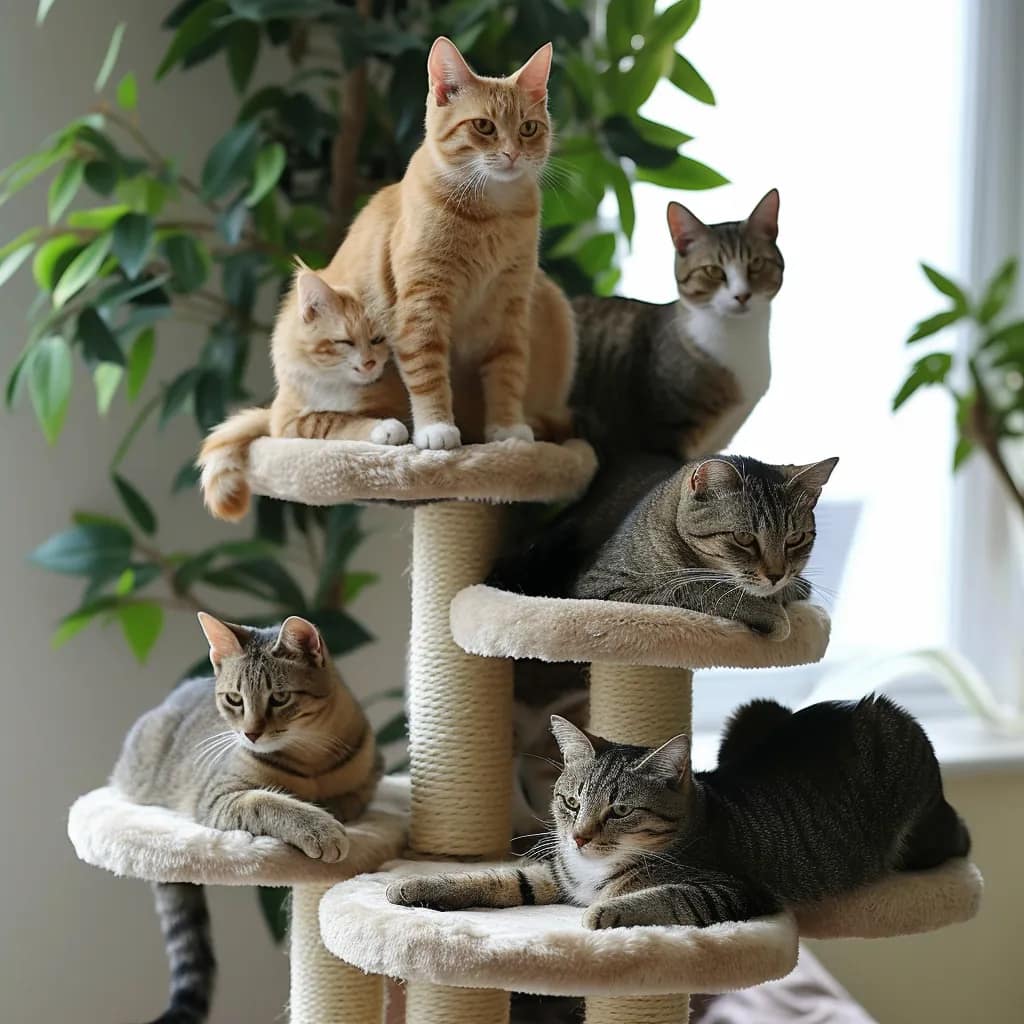
- A young, active indoor cat: a cat tree with several levels to climb and look out from, fixed to the wall.
- An older cat: low, wide scratching spots and a mat or pad on the floor. Older cats scratch less, so keep an eye on their claws too (see how to trim your cat's nails and our guide to the best cat nail clippers).
- Several cats: Cats Protection says every cat should have its own scratching post, in different parts of the house so nobody has to compete. International Cat Care suggests one per cat plus one extra.
- A large or heavy cat: see the section on large cats and Maine Coons above.
Where to put a scratching post
Where the post stands decides whether it gets used. A cat scratches to be seen and to leave its scent, so a post in the corner of the spare room stays untouched. Good spots, based on advice from Cats Protection, International Cat Care and the Wilson survey:
- Next to where your cat sleeps. Cats stretch and scratch right after waking up.
- Exactly where it scratches now. If your cat attacks the arm of the sofa every evening, put the post right next to it.
- In the living room, where you and your cat spend most time.
- By the front door, the cat flap or a window. These are the places where a cat wants to announce that this is its home.
Short on space?
A scratching post does not have to take a square metre of floor. A single post needs about 40 x 50 cm. A sisal mat goes on the wall, the side of a cupboard or the floor. A cardboard scratcher slides under the sofa when visitors come. And if your cat likes to sit high up, a tall post or a wall-mounted shelf uses less space than a wide cat tree.
How to stop your cat scratching the sofa
Most cats need a few days to a few weeks to switch. Petplan advises patience, and these steps work best together:
- Make the sofa less appealing for a while. Cover the spot your cat uses with a thick blanket, or follow Cats Protection's tip of thick, shiny plastic sheeting, which cats do not like to scratch. Wood Green suggests low-tack double-sided tape. Leave the cover on until the post is in regular use.
- Put the scratching post right next to it. Your cat keeps scratching in its favourite spot, just on something else.
- Make the post interesting. Play with a wand toy around the base so your cat claws at it naturally. Rub some catnip into the sisal, or put a few pieces of cat food on the post, as Cats Protection suggests. Not every cat reacts to catnip, so just try it.
- Praise straight away. When your cat uses the post, give a treat or a fuss. Cats Protection advises ignoring scratching on furniture, because any attention, even a telling-off, can reinforce it. In the Wilson survey, reward helped and punishment did not.
- Move it slowly. Once your cat has used the post faithfully for a few weeks, you can shift it in small steps to a spot that suits you better and take the cover off the sofa.
What not to do: do not pick your cat up and drag its paws down the post, which International Cat Care says puts cats off. Shouting or a water spray also backfire, because your cat learns to scratch when you are not around. Cutting the claws short is no fix either. Wood Green says it is not an ethical answer to furniture scratching. Declawing is banned in the UK under the Animal Welfare Act 2006.
New furniture can trigger a sudden burst of scratching, because it smells unfamiliar and your cat wants to mark it. The PDSA suggests covering the likely targets with cardboard for a while and putting sturdy posts nearby. If your cat suddenly scratches a lot, especially by doors and windows, it may feel threatened, often by another cat. Cats Protection warns against simply adding another scratching surface in that case. Pheromone diffusers can help, and the PDSA suggests a microchip cat flap that keeps neighbouring cats out. If your cat seems stressed, talk to your vet or a qualified behaviourist.
Why won't my cat use the scratching post?
Run through these in order:
- It wobbles. Do the push test. A post that moves is the most common reason a cat ignores it.
- It is too short. If your cat cannot stretch out fully, the sofa wins.
- It is in the wrong place. Move it next to the sofa or the bed, where your cat already scratches.
- It is the wrong direction. A carpet scratcher wants something flat. Try a cardboard scratcher or a mat on the floor.
- It is the wrong material. If a sisal post is ignored, try cardboard, woven sisal or carpet.
Looking after a scratching post
Frayed sisal is no reason to buy a new post straight away. Cats like a rough, well-used post that smells of them. Replace the post or the rope when strands hang loose, there are bald patches or the post starts to wobble, which the PDSA also advises. Tighten the screws now and then, and vacuum up hair and sisal fibres while you are at it. A cardboard scratcher is a consumable: expect a few months, depending on how keen your cat is.
Frequently asked questions
What is the best cat scratching post?
For most cats, a sturdy post of about 85 to 90 cm with sisal rope and a wide base, such as the Feandrea 85 cm Thick Scratching Post. If your cat also wants to climb and sleep, the Feandrea Cat Tree for Large Cats is a good choice for bigger breeds. Add a flat cardboard scratcher for cats that scratch the carpet.
How tall should a cat scratching post be?
At least as tall as your cat reaches when it stands on its back legs, so it can scratch at full stretch. For an average adult cat that means 70 to 90 cm of unbroken scratching surface. Cats use posts taller than about 90 cm more often than short ones. Posts of 40 to 60 cm only really suit kittens.
Is sisal or cardboard better for cats?
Sisal lasts longer and is the best choice for an upright post. Cardboard is cheap, gives less resistance and suits kittens, older cats and cats that scratch horizontally. Most cats benefit from having both.
Scratching post or scratching pad?
It depends on how your cat scratches. Cats that go for the sofa arm or door frame want an upright post, cats that rip up the carpet or stair runner want a flat pad. Many cats do both, and cats scratch furniture less when they have more than one type of scratcher.
What is the best scratching post for a Maine Coon?
A Maine Coon needs a thick trunk (11 to 12 cm or more), a wide, heavy base and enough height to stretch out fully. The Feandrea 85 cm Thick Scratching Post is a good single post, and the Feandrea Cat Tree for Large Cats suits Maine Coons that want to climb. Fix any tall tree to the wall.
How many scratching posts does a cat need?
Cats Protection says every cat should have its own post, and International Cat Care suggests one per cat plus one extra. Even with one cat it helps to have two types, an upright post and a flat scratcher, in different rooms.
How do I stop my cat scratching the sofa?
Put a sturdy scratching post right next to the spot your cat uses and cover the sofa for a while with a blanket or shiny plastic sheeting. Make the post attractive with play and catnip, praise your cat every time it uses it, and ignore scratching on the sofa. Never punish your cat.
Does trimming my cat's claws stop it scratching?
No. Scratching is about stretching and marking territory as much as about claws, so a cat with short claws still scratches. Trimming can help an older indoor cat whose claws grow too long, but it does not replace a scratching post. Declawing is illegal in the UK.
At what age can a kitten use a scratching post?
As soon as it comes home. Kittens start scratching young and learn early what is allowed. Start with a flat cardboard scratcher and a low, stable post, and buy a taller one as your kitten grows.