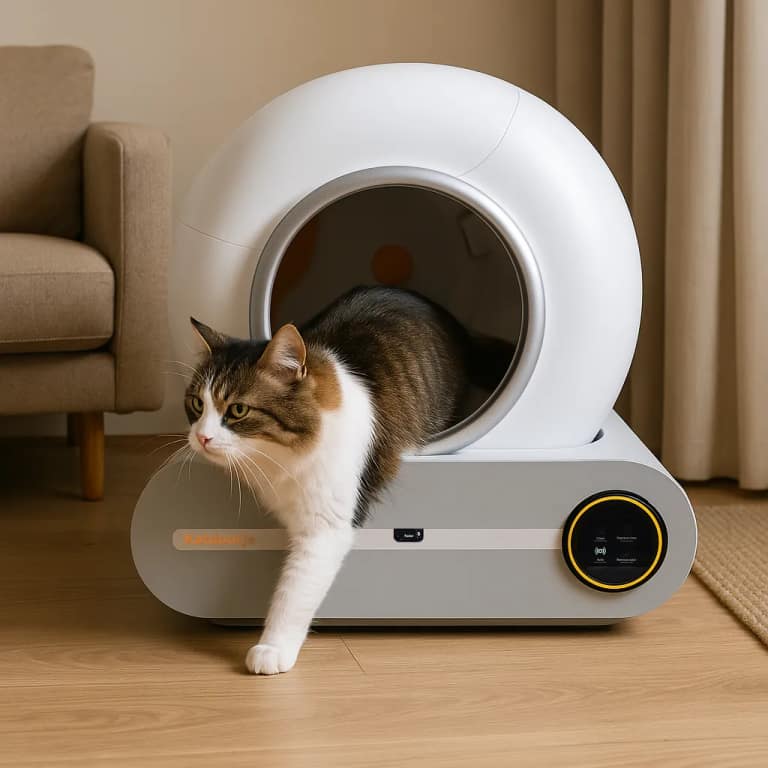
How to Train Your Cat to Use an Automatic Litter Box
In this article
- Before you start: timing, health and litter
- Step-by-step: how to get your cat to use an automatic litter box
- Setting the cleaning delay: timing per brand
- What to do if your cat refuses the automatic litter box
- Kittens and automatic litter boxes: minimum weight and age per brand
- Training more than one cat
- How to get your cat to use a Litter-Robot
- Keeping the box working after training
- Frequently asked questions
To get your cat to use an automatic litter box, place it next to the old tray with the motor switched off, fill it with the litter your cat already knows and add a scoop of used litter. Let your cat use it as an ordinary tray first. Only when your cat goes in without hesitating do you run a cleaning cycle by hand, and after that you switch on automatic mode with a long cleaning delay. Most cats settle within several days to a week. Nervous cats can take a few weeks.
In short
- Days 1 to 3: new box next to the old tray, switched off or in manual mode, same litter plus a scoop of used litter.
- Once your cat uses it: run a cleaning cycle by hand while your cat is in another room, then while your cat watches from a distance.
- Switching on: start automatic mode with the longest cleaning delay your box allows and shorten it later.
- The old tray: keep it until your cat has used the new box reliably for at least a week. Make it a little less attractive, never filthy.
- Kittens: no automatic cleaning below the manufacturer's minimum weight or age. That is 1.36 kg for the Litter-Robot 4, 1 kg for the Neakasa M1 and six months for the PETKIT Pura Max 2 and the PetSafe ScoopFree.
Before you start: timing, health and litter
A little preparation decides most of the outcome. Cats dislike change, and an automatic litter box is a big one: it looks different, smells of plastic and moves on its own.
- Pick a calm week. Avoid introducing the box while you are moving house, bringing home a new pet or having building work done. Stress alone can make a cat avoid a tray.
- Check your cat is healthy. If your cat already has toilet problems, such as weeing outside the tray or straining, see your vet first. A medical problem looks exactly like a cat that "refuses" the new box.
- Check the litter. Most rotating boxes need a clumping litter. The Litter-Robot 4 works with nearly any clumping litter but not with wood pellets, newspaper or non-clumping litter, according to Whisker. The PetSafe ScoopFree uses crystal trays. If your cat now uses a litter that will not work in the new box, change the litter first, in the old tray, by mixing in the new litter over several days. Changing the litter and the box at the same time is asking for trouble. Our guide to the best cat litter compares clumping clay, wood, silica and tofu litters.
- Check the fit. Your cat needs room to turn around and dig, and the entrance must suit an older or stiff cat. A box that is too small or too high is a common reason for refusal.
Still choosing a box? Our guide to the best automatic cat litter boxes compares the models by cat weight, entrance size, number of cats and litter type, which are the things that decide whether your cat will accept it.
Step-by-step: how to get your cat to use an automatic litter box
This plan follows the advice of the manufacturers themselves (Whisker, PETKIT, Neakasa and PetSafe) and of the UK charity Battersea. Move to the next step only when your cat is relaxed with the current one. If your cat gets scared, go back a step.
How do you know your cat is ready to move on? Your cat walks into the box without stopping at the entrance, digs and covers as usual and leaves calmly. Signs to slow down are sniffing and walking away, flattened ears or a puffed-up tail at the sound, fewer visits than before, or wees and poos right next to the box.
Step 1: put it next to the old tray, switched off (days 1 to 3)
- Place the automatic box in the same spot as the current tray, or right next to it. Cats go where they always go.
- Leave it unplugged, or switch on manual or kitten mode so it cannot cycle by itself.
- Keep the old tray where it is and keep cleaning it as normal for now. Your cat must always have a toilet it trusts.
- If your box has a removable hood or lid, you can leave it off for the first days so your cat never feels trapped.
- Let your cat sniff and explore. Never lift your cat into the box. Being put into something new and strange is the quickest way to make your cat avoid it.
Step 2: make it smell like the toilet
- Fill the new box with the same litter your cat uses now, up to the fill line.
- Add a scoop or a cup of used litter from the old tray. Whisker recommends this for the Litter-Robot, and it tells your cat what the new box is for.
- While the box is switched off, scoop it by hand, just like an ordinary tray.
Step 3: reward every visit
- Put a few treats or a little catnip on the step or around the box, outside the cleaning area.
- Sit next to the box with your cat now and then. A calm owner nearby helps a cautious cat.
- When your cat uses the new box, give praise or a treat afterwards. Do not disturb your cat while it is going.
Step 4: run the first cycles by hand (usually days 4 to 7)
Once your cat has used the new box a few times, it is time for movement and sound.
- Run the first cleaning cycle by hand while your cat is in another room, a few minutes after a visit so the clump has formed.
- Then run a cycle while your cat can see and hear it from a distance, ideally while you are there with a treat or a toy.
- If your cat runs off or puffs up, switch back to manual cleaning for a few more days. Neakasa gives exactly this advice: power off and go back a step.
Step 5: switch on automatic mode with a long delay (week 2)
- When your cat uses the box consistently and is not bothered by the sound, switch on automatic mode.
- Set the cleaning delay as long as possible for the first weeks, so the box stays still while your cat is nearby. On the Litter-Robot 4 you can extend it up to 30 minutes for skittish cats.
- Use sleep mode or a quiet schedule if your box has one, so the box does not cycle at night next to a sleeping cat.
- Check the app or the box daily. A drop in visits is your first warning that something is wrong.
Step 6: phase out the old tray (from week 2 or 3)
- Make the old tray a little less attractive. Whisker suggests no longer scooping it, PetSafe suggests leaving the waste for one day. In practice, scooping it once a day instead of after every visit is often enough. Do not let it become filthy: a cat that finds both toilets unacceptable will go on the floor.
- Remove the old tray only after your cat has used the automatic box reliably for at least a week.
- If you see accidents, put the old tray back and slow down.
- Many owners keep an ordinary tray in another room as a spare, for power cuts, sensor faults and the days you are emptying or washing the automatic box. With more than one cat, you need extra trays anyway (see below).
Setting the cleaning delay: timing per brand
The cleaning delay is the waiting time between your cat stepping out and the box starting to clean. It does two things. It gives the litter time to clump, so the box can sift out a firm clump cleanly. And it keeps the box still while your cat is still close by. During training, longer is better.
| Box | Cleaning delay | Manual or kitten mode |
|---|---|---|
| Litter-Robot 4 (Whisker) | Adjustable, up to 30 minutes for skittish cats | Semi-automatic: leave it switched off, power it on after a visit to run one cycle, then switch it off again |
| PETKIT Pura Max 2 | Set in the PETKIT app under the smart settings | Kitten Mode in the app switches off automatic and periodic cleaning. Use "Clean now" by hand |
| Neakasa M1 | Set in the Neakasa app | Kitten Mode. Wait about 5 minutes after a visit, then press Clean on the box or in the app |
| PetSafe ScoopFree (2nd generation) | The rake runs about 20 minutes after your cat leaves | Leave it unplugged and scoop by hand |
Once your cat is fully used to the box, you can shorten the delay. Keep it long enough for your litter to form firm clumps. If you see smeared or broken clumps in the drawer, the delay may be too short for that litter.
What to do if your cat refuses the automatic litter box
Some cats need weeks, and a few never accept a box that moves. Battersea warns that automated or self-cleaning trays can put cats off because of the noise, movement or smell. Work through the likely causes before you give up.
Your cat goes nowhere near it
- Switch it off again and go back to step 1. Many cats need longer than three days just to accept the object.
- Move it a little away from walls or corners where your cat might feel trapped, but keep it in the usual toilet area.
- Whisker's own tip for the Litter-Robot: put a large cardboard box over the unit with holes cut out for the entrance and the drawer. It then looks and feels more like a familiar covered tray.
- Use more of the used litter from the old tray.
- Try a litter attractant. Whisker suggests a "cat attract" litter or additive, which you sprinkle into the litter your cat already uses.
Your cat is scared of the noise or the movement
- Go back to manual cycles while your cat is in another room, and build up from there.
- Make the cleaning delay as long as possible.
- Pair the sound with something good: run a cycle at feeding time, at the other end of the room.
- Check that nothing rattles. A box on an uneven floor or soft carpet can sound louder and wobble.
Your cat only uses the old tray
That usually means your cat accepts the new box but still prefers the old one. Make the old tray a bit less attractive as described in step 6, and keep the new one spotless. Also look at what your cat does where. PetSafe points out that some cats like one tray for wees and another for poos, and a cat like that may happily use both for good. If your cat sticks to the old tray for weeks, compare the two: litter type, litter depth, entrance height, hood or no hood. Cats that have always used an open tray often struggle with an enclosed drum, and an open-top automatic model may suit them better.
Your cat goes outside the box
Put the old tray back straight away and clean the spot thoroughly, ideally with an enzyme cleaner, because a lingering smell invites your cat back. Our guide to the best enzyme cleaner for cat urine explains how to do that.
If it keeps happening, the cause may not be the box at all. Our article on why your cat is pooping outside the litter box goes through the medical and behavioural reasons.
When to call your vet
Call your vet straight away, or an out-of-hours vet at night, if your cat keeps going to the tray and strains but produces little or no urine. Especially in male cats, this can be a blocked urethra. The Cornell Feline Health Center calls it a true medical emergency that can be fatal within 24 to 48 hours. Crying while trying to wee or blood in the urine also needs a vet the same day. Also see your vet if your cat suddenly avoids every tray, has diarrhoea or seems unwell. A cat in pain often links the pain to the tray it was using.
Kittens and automatic litter boxes: minimum weight and age per brand
An automatic box detects your cat by weight and other sensors. A kitten that is too light may not be detected, and then the box could start a cycle with the kitten inside or close by. That is why every manufacturer sets a minimum. Below it, use the box as an ordinary tray with the automatic cleaning switched off.
| Box | Automatic mode from | Below that |
|---|---|---|
| Litter-Robot 4 | 1.36 kg (3 lb) | Semi-automatic: switched off, power on after a visit (wait about 7 minutes for the clump), then off again |
| Neakasa M1 | 1 kg (2.2 lb) | Kitten Mode, clean by hand once or twice a day when the kitten is not inside |
| PETKIT Pura Max 2 | 6 months and at least 1.5 kg | Kitten Mode, use "Clean now" by hand |
| PetSafe ScoopFree (2nd generation) | 6 months | Leave it unplugged and scoop by hand |
Two practical points. A young kitten also needs a low entrance it can climb into easily, so many owners give a kitten an ordinary low tray first and introduce the automatic box once the kitten is big enough. And kittens learn fast: a kitten that has used the box in manual mode for months usually accepts the cleaning without fuss. For the right litter at each age, read our guide to the best cat litter for kittens.
Training more than one cat
- Keep enough trays. Battersea's rule for multi-cat homes is one tray per cat, plus one extra. An automatic box counts as one tray, even if the manufacturer says it can handle several cats. Whisker rates the Litter-Robot 4 for up to four cats. That figure is about what the box can handle. Whether your cats are willing to share is a separate question.
- Expect different speeds. The bold cat often uses the new box on day one, while the shy one waits. Keep the old trays until the slowest cat is using the new box too.
- Watch the cycle with two cats around. A second cat can arrive just as the countdown is running. Good boxes stop when a cat comes close, but a long delay during the training weeks gives extra peace of mind.
- Do not trust the app blindly. Apps tell cats apart by weight. Cats of similar weight are often mixed up, so check visits per cat with your own eyes for the first weeks.
- Mind tension between cats. If one cat guards the area around the box, the other may stop using it. Put a second tray somewhere else in the house.
How to get your cat to use a Litter-Robot
The Litter-Robot is the box people search for most by name, so here are the steps Whisker gives for it, in short.
- Place it where the old tray was and keep the old tray nearby for a short time.
- Leave it switched off at first and use it in semi-automatic mode: after your cat has used it, power it on so it runs one cycle, then switch it off again. Whisker recommends this as the best way to acclimate a cat.
- Mix a scoop of used litter from the old tray into the clean litter.
- Put treats or catnip on the step or around the unit, and reward your cat after a visit.
- Switch to automatic mode once your cat uses it consistently. Start with a long cycle delay. On the Litter-Robot 4 you can extend it up to 30 minutes.
- Fill the globe to just below the raised MAX line when the litter is spread flat. Too much or too little litter can affect the cycle.
- Place it on a firm floor. On carpet the weight sensor is less accurate, and Whisker sells a carpet tray for that.
According to Whisker, most cats use a Litter-Robot within several days to a week. Cats that already know a covered tray tend to adjust faster.
Keeping the box working after training
A cat that has just accepted the new box can drop out again if the box starts to smell or misbehaves. A few habits help.
- Empty the waste drawer or bag before it is full. How often depends on the size of the drawer and the number of cats, and most app models tell you when it is time.
- Keep the litter at the fill line and top it up when you empty the drawer.
- Wipe the sensors and give the whole box a proper wash now and then, following the manual of your model.
- Replace carbon filters on the schedule the manufacturer gives.
For washing, hygiene and how often to replace litter, see our complete guide to cleaning the litter box.
Frequently asked questions
How long does it take to train a cat to use an automatic litter box?
Most cats use an automatic litter box within several days to a week, which is also what Whisker reports for the Litter-Robot. Shy or older cats, and cats that have always used an open tray, can take a few weeks. Keep the old tray available until your cat has used the new box reliably for at least a week.
Should I keep the old litter box when switching to an automatic one?
Yes, at least during training. Place it next to the new box and keep it clean at first, then make it a little less attractive by scooping it less often. Remove it only when your cat uses the automatic box consistently. Many owners keep an ordinary tray as a permanent spare.
Should the automatic litter box be switched off at first?
Yes. Every manufacturer advises starting with the box switched off or in manual mode, so your cat can get used to it without noise or movement. Run the first cleaning cycles by hand, and switch on automatic mode only when your cat uses the box without hesitating.
My cat is scared of the automatic litter box. What can I do?
Go back to manual mode and run cycles only while your cat is in another room. Then let your cat watch a cycle from a distance with a treat or a toy, and set the cleaning delay as long as possible. Never put your cat into the box.
What cleaning interval should I set on an automatic litter box?
During training, set the longest delay your box allows, so it stays still while your cat is nearby. On the Litter-Robot 4 that is up to 30 minutes. Later you can shorten it, as long as your litter forms firm clumps before the box starts.
Can kittens use an automatic litter box?
Only once they meet the manufacturer's minimum. That is 1.36 kg for the Litter-Robot 4, 1 kg for the Neakasa M1, and six months for the PETKIT Pura Max 2 and the PetSafe ScoopFree. Until then, switch off the automatic cleaning and use the box as an ordinary tray, or give the kitten a low ordinary tray.
Are automatic litter boxes safe for cats?
Well-known models such as the Litter-Robot 4 and the PETKIT Pura Max 2 combine weight sensors with laser or proximity sensors and pause the cycle when a cat steps in or comes close. The main risk is a cat the sensors cannot detect, which is why every manufacturer sets a minimum weight or age for automatic mode. Keep kittens below that limit on manual mode, keep the sensors clean and stay with the box for the first automatic cycles.
Can two cats share one automatic litter box?
Many automatic boxes are made for several cats, but cats still need choice. Keep one tray per cat plus one extra, as Battersea advises. Train each cat at its own pace and keep the old trays until the slowest cat uses the new box.
What if my cat still won't use the automatic litter box?
Check the litter, the entrance height, the size and whether the box is enclosed, and go back to the first step. If your cat avoids every tray, strains or goes outside the box, see your vet. Some cats never accept a box that moves, and then an ordinary tray is the kinder choice.