Cats and Christmas Trees: How to Cat-Proof Your Tree
In this article
You can have a Christmas tree and a cat in the same room. Stand the tree in a heavy base in a corner, hang shatterproof baubles at the bottom, leave out the tinsel, tuck the fairy light cables away and keep lilies out of the house altogether. Most of the real danger at Christmas comes from what is on and around the tree: tinsel and ribbon that can block the gut, chocolate on the branches, lilies in a bouquet and festive plants within paw's reach. The tree itself is mostly a climbing problem.
This article contains affiliate links How it works
Katdootje earns a small commission if you buy through a link in this article. It costs you nothing extra and does not influence what we recommend. As an Amazon Associate, Katdootje earns from qualifying purchases.
In short
- Most important: no lilies in the house, not even in a bouquet. A nibble of a leaf, a little pollen licked off the coat or a drink of vase water can cause kidney failure.
- Skip the tinsel: swallowed tinsel can block the gut and need emergency surgery.
- Baubles: shatterproof plastic on the lower branches, anything glass or precious near the top.
- The tree: a sturdy, weighted base, in a corner away from furniture your cat can jump from. Let it stand bare for a few days before you decorate. With a real tree, cover the water and sweep up needles daily.
- Products that help: the Krinner Comfort Christmas Tree Stand M for a real tree, KI Store Shatterproof Baubles, a Feandrea 85 cm Thick Scratching Post near the tree and a Go Cat Da Bird wand to tire out a young climber. Why we chose it
When to call the vet straight away
Read this first, because the rest of the article is about preventing these situations. Call your vet, or the out-of-hours number if the practice is closed over Christmas, if your cat:
- has touched a lily in any way. Chewed a leaf, licked pollen off its fur or drunk water from the vase. International Cat Care calls this an emergency that needs urgent veterinary care, and the PDSA says never to wait for symptoms. Early treatment makes a big difference.
- may have swallowed tinsel, ribbon, string or part of a bauble, especially if it then vomits, has diarrhoea, goes off its food or seems lethargic.
- has eaten chocolate from the tree or from under it. Cats Protection says chocolate is poisonous to cats even in tiny amounts.
- has chewed mistletoe, holly, poinsettia, ivy or amaryllis. The PDSA advises calling your vet immediately, even if your cat seems fine. Know which plant it was and roughly how much is missing.
- has drunk tree water with additives in it, or eaten sap or oil from the branches.
- has bitten through a cable or has burns around the mouth. Switch off at the mains before you touch your cat.
International Cat Care advises taking the packaging, the plant or the substance with you to the vet. Cats Protection says the same.
Why cats go for the Christmas tree
From your cat's point of view a tree has suddenly appeared indoors, with new smells, branches to climb and shiny things that swing when you bat them. Cats Protection points out that hanging baubles look just like toys. A young cat or kitten will almost certainly try to climb it. An older cat may just sniff it and lie underneath. Daily play with interactive cat toys gives a young cat a better target.
That is why the plan below starts before the first bauble goes on.
Real or artificial tree?
Both can work. The PDSA says artificial trees are generally the safer choice, although a cat can still hurt itself climbing one.
A real tree
- Needles. The PDSA says pine and spruce needles are not toxic. They can still get stuck in the soft palate, irritate the gut if swallowed and hurt eyes and paws. PETA UK suggests choosing a fir, whose needles are flat and soft, over a spruce or pine. Keep the tree watered so it drops fewer needles, and hoover up fallen ones every day.
- Tree water. Curious cats like to drink from the tree stand. Standing water can grow bacteria that upset the stomach. Do not add plant food, fertiliser or preservatives, cover the stand with a tree skirt or netting and keep a bowl of fresh water elsewhere.
- Sap and oil. The PDSA warns that sap and oil from the branches are toxic. Small amounts can cause vomiting and diarrhoea, and large amounts can harm the liver or kidneys.
An artificial tree
- No needles, no water and no sap, which removes three risks at once.
- Many artificial trees come with a light folding stand. Weigh the stand down or put the tree in a heavier base so it cannot tip when your cat jumps in.
- Keep an eye out for bits of plastic "needle" that come loose, especially with a kitten.
A cat-proof or tabletop tree
Petplan points to two options that take most of the climbing out of the picture. Some sellers offer real trees as "cat-proof" trees, with the lower branches cut off so the decorations start above your cat's reach. A small tabletop tree does far less damage if it does get knocked over.
How to cat-proof your Christmas tree
1. A heavy base in the right spot
Cats Protection advises a sturdy base, or weights to stop the tree toppling over. A tree that falls can injure your cat and anyone nearby, and break everything on it. Stand the tree in a corner so it has walls on two sides, and away from sofas, shelves and windowsills your cat could use as a launch pad. If your cat is a climber, secure the top to the wall or ceiling with an eye hook and twine or thin wire, as Petplan and the vet and behaviourist quoted by Chewy advise.
2. Let the tree stand bare for a few days
Petplan and Yours magazine both suggest putting the tree up a few days before you decorate it. Behaviourist Stephen Quandt, quoted by Chewy, says the tree is often most interesting when it first arrives, with its new smell and the cold air it brings in. Give your cat a day or two to sniff it and lose interest, then add the lights and baubles.
3. Shatterproof baubles at the bottom
Both Cats Protection and the PDSA advise avoiding glass baubles. A broken one can cut paws, and a swallowed one can lodge in the throat or the gut. Hang shatterproof plastic, felt, wooden or paper decorations on the lower third of the tree, where your cat can reach, and keep the glass or sentimental ones near the top.
Skip metal hooks. Petplan warns that sharp hooks can hurt a cat's mouth or paws, and PETA UK advises against metal hooks altogether. Tie baubles on with thread instead, as Petplan suggests, and check the floor now and then for anything that has dropped.
4. Leave out the tinsel
The PDSA warns that swallowed tinsel can cause serious injury and a blockage in the gut that needs emergency surgery. Cats Protection adds that tinsel and ribbon can get caught around a cat's neck or legs. The simplest answer is no tinsel at all. If you cannot do without, keep it high and out of reach.
5. Fairy lights and cables
- Run the cable to the socket behind furniture, or cover it with a plastic or cardboard tube, as Cats Protection suggests.
- Switch the lights off at the mains when you go out or go to bed.
- Use low-voltage lights where you can. The PDSA warns that higher-voltage lights carry a risk of electric shock.
- Wind the lights around the middle of the tree (Petplan) and deep into the branches (PETA UK), with no loops hanging down for a cat to pull.
- Battery-powered lights do away with the mains cable. PETA UK warns that a punctured battery can leak harmful chemicals into a cat's mouth, so tuck the battery box out of reach.
6. No chocolate on the tree
Chocolate decorations hung on the branches are an easy target. Cats Protection says chocolate is poisonous to cats even in tiny amounts. Keep chocolate, mince pies and Christmas pudding away from the tree altogether. Which festive foods are safe for your cat is in what human food cats can eat.
7. Presents and wrapping
Cats Protection advises against putting presents for your cat under the tree, especially catnip toys, because they only draw your cat in. Gift ribbon and curling ribbon are as risky as tinsel. Tidy wrapping away straight after the presents are opened.
8. Artificial snow
The PDSA says spray snow made in the UK is usually low risk, but imported products may be toxic and a large amount can cause a blockage.
9. Give your cat something better to do
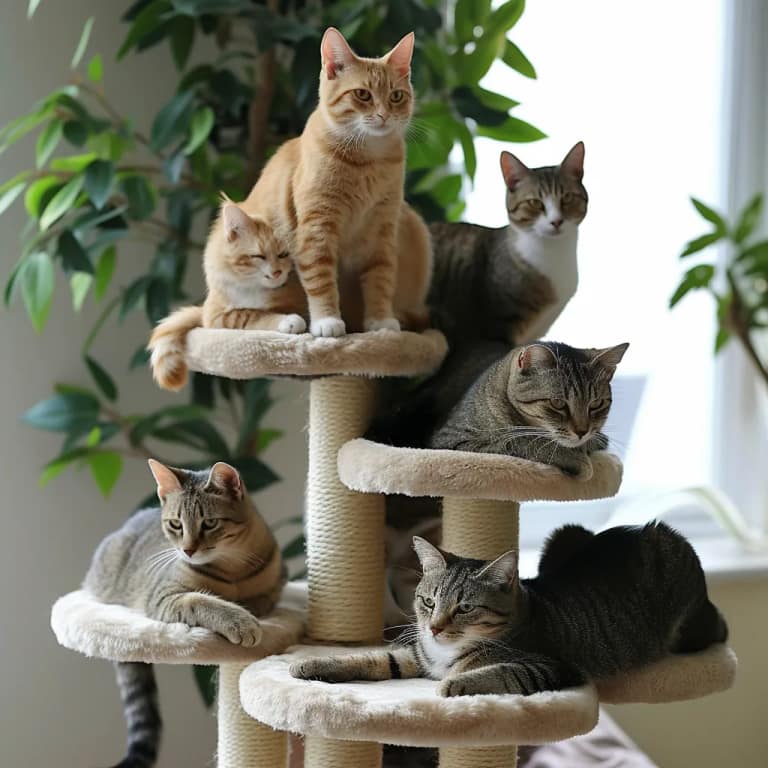
A cat that has a good place to climb and scratch is less interested in the tree. A scratching post or cat tree in the same room, with a toy on it, gives the energy somewhere to go. Samantha Bell, a cat trainer at Best Friends Animal Society quoted by Chewy, suggests giving your cat its own tree with toys and treats on it, rewarding it for playing there and ignoring its attempts at the Christmas tree. Play with your cat for a few minutes before you leave the room, and shut the door to the tree room at night or when you are out. More on choosing a post that your cat will use is in the best cat scratching post.
Deterrents and barriers around the tree
If your cat keeps going for the tree despite all this, make the base unpleasant or out of bounds. These are the methods UK pet sites mention most.
| Method | How to use it | Good to know |
|---|---|---|
| Tin foil | Wrap it around the stand and the bottom of the trunk | Many cats dislike the feel under their paws (Petplan, Yours). Clear away torn bits, as a ball of foil soon becomes a toy. |
| Citrus peel | Lay orange or lemon peel around the base | Cats generally dislike the smell (Petplan, Yours). Use the peel only. The PDSA lists citrus oils among the essential oils that are toxic to cats, so no citrus oil sprays or diffusers near the tree. |
| Pine cones or empty wrapped boxes | Make a ring around the base | An extra barrier between your cat and the trunk (Petplan) |
| Bells on the lowest branches | Hang a few bell decorations near the bottom | An early warning. You hear your cat at the tree, even from the next room (Petplan, Yours) |
| Baby gate, pet gate or fire guard | Put it around the tree, or across the doorway of the room | Keeps your cat away from the tree altogether, useful with kittens and determined climbers (Petplan, Chewy) |
Christmas plants and cats
Flowers and plants are easy to forget at Christmas. Lilies turn up in bouquets, and poinsettias, mistletoe, holly and amaryllis are popular gifts. Petplan also lists cyclamen, and Cats Protection warns about dumb cane (Dieffenbachia), a common houseplant.
| Plant | How dangerous | Signs to look for | What to do |
|---|---|---|---|
| Lilies (true lilies and day lilies) | Life-threatening. A tiny amount of any part, the pollen or the vase water can be enough. | Drooling, vomiting, off food, lethargy, within 1 to 6 hours. Kidney failure can follow days later. | Emergency. Call your vet at once, even without symptoms. |
| Poinsettia | Toxic, usually mild signs | Drooling, mouth irritation, vomiting, diarrhoea | Call your vet |
| Mistletoe | Toxic, the berries especially | Vomiting, diarrhoea, tummy pain, unsteady walk, collapse | Call your vet |
| Holly | Berries toxic, leaves can injure | Drooling, vomiting, diarrhoea, pawing at the mouth, head shaking | Call your vet |
| Ivy | Harmful if eaten | Vomiting, diarrhoea, tummy pain, skin irritation | Call your vet |
| Amaryllis | Poisonous (contains lycorine) | Vomiting, drooling, lethargy, tremors or fits | Call your vet |
Sources: International Cat Care and the PDSA (lilies), the PDSA (other plants), Cats Protection (lilies, mistletoe, holly, amaryllis).
Lilies in bouquets
All true lilies (Lilium, including Easter, tiger, stargazer and Asiatic lilies) and day lilies (Hemerocallis) are poisonous to cats, says International Cat Care. Every part counts: flowers, leaves, stem and pollen. A cat can be poisoned just by brushing past a bouquet and licking the pollen off its fur, or by drinking from the vase. "Pollen-free" lilies are not safe either. The PDSA advises taking lilies out of any bouquet before it comes into the house. If you are sending flowers to someone with a cat this Christmas, ask the florist to leave the lilies out.
Peace lilies, calla lilies and lily of the valley are not true lilies. International Cat Care notes they may have different toxic effects. They are still not plants to leave within reach. Which other houseplants, garden plants and cut flowers are risky is in our guide to plants poisonous to cats.
Poinsettia
The PDSA lists poinsettia as toxic to cats, with drooling, mouth irritation, vomiting and diarrhoea. The American ASPCA describes its toxicity as generally over-rated. That is still no reason to leave it within reach. At Christmas 2015 the PDSA treated Elsa, a six-month-old kitten from Rotherham who was vomiting and collapsing after nibbling a poinsettia on Christmas Day. She needed a drip and a night in hospital. Keep it on a high shelf or in a room your cat does not use.
Mistletoe and holly
Both are traditional in British homes and both have toxic berries. Cats Protection and the PDSA warn against letting cats eat them. Holly leaves are also sharp. Hang mistletoe high, and keep holly for a wreath on the outside of the front door.
Safer festive greenery
If you want plants in the house over Christmas, the ASPCA lists the Christmas cactus (Schlumbergera) as non-toxic to cats. For a full list of plants that are safe or toxic for cats, the ASPCA plant list is the most complete source.
Kittens and Christmas
The PDSA advises extra care with kittens who have never had a Christmas before. With a kitten in the house, think about a small tabletop tree in a room you can close off, or a tree with only shatterproof baubles and no lights on the lower half. Supervise every time the kitten is in the room with the tree. Still looking for a name for your new kitten? A festive one from our Christmas cat names suits the season.
The holidays end with New Year's Eve, and the fireworks frighten many cats more than any tree. Bring your cat in before dark that evening, lock the cat flap and make sure it has a quiet room and somewhere to hide. Our guide to cats and fireworks explains how to prepare.
Products that make it easier
You do not need to buy much. These four cover the basics: a stand that does not tip, baubles that do not break, somewhere better to climb and a toy to tire out a young climber. All four were in stock on Amazon UK in early November 2026.
Frequently asked questions
Are Christmas trees poisonous to cats?
The needles themselves are not toxic. They can injure the mouth, eyes and gut if your cat chews or swallows them. Sap, oil and tree water with additives are more of a concern. The decorations and plants around the tree usually cause more trouble than the tree itself.
How do I stop my cat climbing the Christmas tree?
Use a heavy base, put the tree in a corner away from furniture and tie the top to the wall or ceiling if your cat is a climber. Let the tree stand bare for a few days before you decorate, give your cat a scratching post or cat tree nearby and close the door when you are out.
What can I put around the Christmas tree to keep my cat away?
Tin foil around the stand, orange or lemon peel at the base and a ring of pine cones or empty boxes are the usual tips. Stick to the peel, because citrus essential oil is toxic to cats. For a kitten or a cat that keeps climbing, a baby gate or fire guard around the tree keeps it away altogether.
Is an artificial tree safer for cats?
Generally yes, says the PDSA. There are no needles, water or sap. A cat can still climb it and pull it over, so a stable base matters just as much.
Is tinsel dangerous for cats?
Yes. Swallowed tinsel can cause a gut blockage that may need emergency surgery. If your cat may have eaten some, call your vet, especially if it vomits or goes off its food.
Are poinsettias poisonous to cats?
They are toxic to cats. The usual signs are drooling, a sore mouth, vomiting and diarrhoea, and the PDSA has treated a kitten who needed a drip. Keep the plant out of reach and call your vet if your cat has chewed it.
Can I have lilies at Christmas if I have a cat?
No. Every part of a lily, including the pollen and the vase water, can cause fatal kidney failure in cats. Take lilies out of bouquets before they come into the house.
Sources for this guide
- Cats at christmas (cats.org.uk)
- Dangerous christmas decorations to be aware of if you re a pet owner (pdsa.org.uk)
- Five christmas plants that are dangerous to pets (pdsa.org.uk)
- Lily poisoning in cats (pdsa.org.uk)
- Lily poisoning in cats (icatcare.org)
- Cats and poisons (icatcare.org)
- Christmas cat astrophe avoided thanks to pdsa (pdsa.org.uk)
- Cats and essential oils advice (pdsa.org.uk)